What Should You Get Rid of Before Moving? A Junk Removal Guide for Cumming, GA Homeowners
Moving Less Can Save Time, Space, and Unnecessary Work
Preparing for a move often begins with boxes, tape, labels, and a growing list of tasks. Before packing everything in sight, however, homeowners should decide which belongings are actually worth taking to the new property. Moving unwanted furniture, broken household items, and years of stored clutter creates additional work at every stage of the process.
For homeowners in Cumming, Alpharetta, Dawsonville, Gainesville, Johns Creek, Forsyth County, and surrounding North Georgia communities, a pre-move cleanout can make the entire relocation more manageable. Every item removed before packing is one less thing that must be wrapped, carried, loaded, transported, unloaded, and organized again.
It is common to pack belongings simply because they are already inside the home. A box may have remained unopened through several moves, yet it gets placed on the truck again without anyone checking what is inside. Old furniture may be moved to a garage or storage room at the new property, where it continues taking up space without serving a useful purpose.
Decluttering before moving helps homeowners make intentional decisions instead of transferring the same problem to a new address. It can also provide a clearer picture of how much packing material, truck space, and moving labor will actually be needed.
A pre-move cleanout can be especially helpful for:
- Families moving into a smaller home
- Homeowners preparing for a long-distance move
- Seniors transitioning into a more manageable residence
- Couples combining two households
- Families clearing an inherited property
- Homeowners preparing a house for listing or photography
- People emptying garages, attics, basements, or storage units
- Businesses relocating to a smaller or redesigned workspace
Downsizing requires particularly careful planning. Furniture that fits comfortably in the current home may overwhelm a smaller living room or bedroom. Large dining sets, oversized entertainment centers, extra shelving, and duplicate appliances should be compared with the dimensions and layout of the new property before they are placed on the moving truck.
Long-distance moves can also make decluttering more valuable. Transporting items over a greater distance requires additional truck space, handling, and coordination. Paying to move belongings that will be donated or discarded immediately after arrival creates avoidable effort and expense.
Common signs that a household may need a cleanout include:
- Boxes that have remained unopened for several years
- Broken furniture that has never been repaired
- Duplicate kitchenware, tools, or small appliances
- Exercise equipment that is no longer used
- Old mattresses, bed frames, or damaged shelving
- Garage clutter that blocks vehicles or storage areas
- Items that will not fit the layout of the new home
- Unused office furniture or outdated electronics
- Leftover materials from completed renovation projects
- Belongings kept only because no one has decided what to do with them
Homeowners who are unsure what to keep can ask a few practical questions. Has the item been used within the last year? Does it fit the new home? Is it in good condition? Would it be purchased again today? Is the item valuable enough to justify the space and effort required to move it?
Other useful questions include:
- Does this item serve a clear purpose?
- Is it a duplicate of something else being moved?
- Will there be an appropriate place for it at the new property?
- Would replacing it later be easier than transporting it now?
- Is it being kept because it is useful or simply because it has always been there?
- Does it have genuine sentimental value?
- Would someone else benefit from receiving it?
Sentimental belongings deserve a different approach from ordinary household clutter. Photographs, family documents, heirlooms, and meaningful keepsakes should not be sorted quickly under the pressure of moving day. These items can be reviewed separately and packed in clearly labeled containers.
Large unwanted items should be identified early. Couches, mattresses, appliances, desks, and exercise machines can interfere with packing and staging if they remain in the home until the final day. Removing them in advance creates more room for boxes and gives the moving crew clearer pathways through the property.
Reducing the amount being moved can affect several parts of the relocation:
- Fewer boxes and packing supplies may be required
- Movers have fewer items to carry and load
- Less truck space may be needed
- Loading and unloading may be completed more efficiently
- The new home is less likely to become immediately cluttered
- Unpacking decisions become simpler
Sorting should begin before the professional movers arrive. Trying to decide whether each item stays or goes while the truck is being loaded slows the process and creates confusion. It can also increase the risk of something being moved or removed accidentally.
A clear system makes the process easier. Homeowners can designate separate areas for items that will be moved, donated, sold, or removed. Colored labels or large signs can help everyone working in the home understand what belongs in each category.
Selling unwanted belongings can be useful when there is enough time, but it should not become another major source of stress. Listing, photographing, messaging buyers, and arranging pickups may require more time than expected. Items with limited resale value may be better suited for donation or professional removal.
Once decisions have been made, junk removal provides a practical way to clear bulky or unwanted belongings from the home. A removal crew can handle items that may be difficult for homeowners to lift, carry downstairs, or transport using a personal vehicle.
B&B Moving & Delivery can coordinate junk removal with residential or commercial moving services throughout Cumming, North Georgia, and Metro Atlanta. Clearing unwanted items before packing begins can help create a more organized move and a cleaner start at the new property.

Common Items Homeowners Leave Behind
Junk removal can include much more than bags of household trash. During a pre-move cleanout, homeowners often discover large furniture, outdated equipment, damaged storage pieces, and boxes of unused belongings that are difficult to handle without help.
The items found during a cleanout depend on the age of the household, the amount of available storage, and how long the family has lived in the property. Garages, basements, attics, spare bedrooms, and storage sheds tend to collect items that are rarely seen during everyday life.
Common items removed before a move may include:
- Old couches, recliners, and upholstered chairs
- Mattresses, box springs, and bed frames
- Broken tables, desks, bookcases, and shelving
- Unwanted washers, dryers, refrigerators, or small appliances
- Treadmills, weight benches, and other exercise equipment
- Garage cabinets, workbenches, and damaged storage containers
- Unused lawn equipment and outdoor furniture
- Boxes of outdated household goods
- Leftover flooring, wood, tile, or renovation materials
- Office desks, chairs, filing cabinets, and cubicle components
- Old televisions, computer equipment, and entertainment centers
- Children’s furniture, toys, and equipment that are no longer needed
The condition of an item helps determine what should happen next. Furniture that is clean, safe, and usable may be suitable for donation or resale. Broken, stained, unstable, or heavily worn pieces may need to be removed instead.
Homeowners should remember that donation organizations may have restrictions. Some do not accept mattresses, damaged upholstered furniture, large appliances, or items with missing parts. It is helpful to confirm acceptance policies before loading a vehicle or arranging a pickup.
What Should Be Donated, Recycled, Discarded, or Moved?
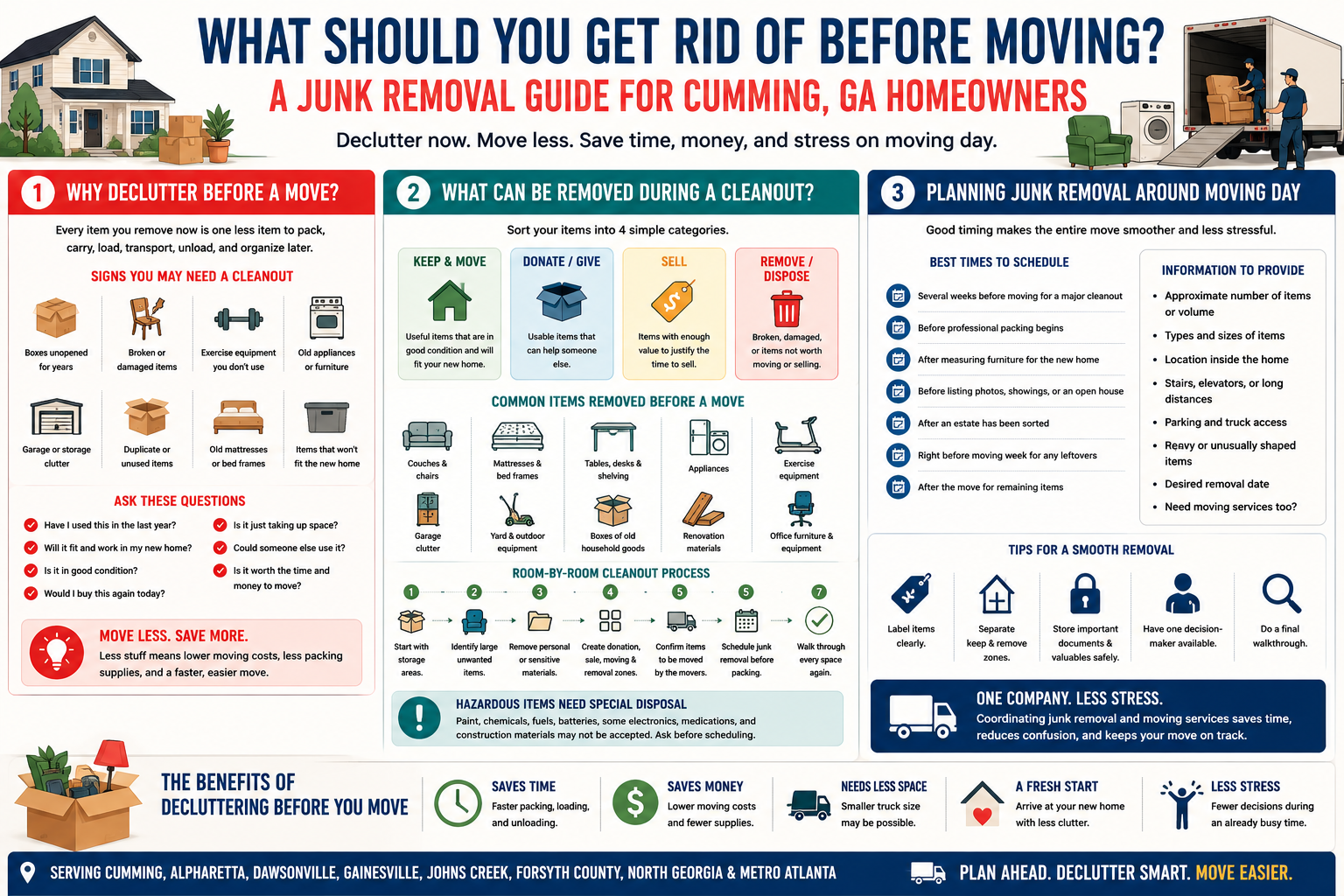
A four-category sorting system can keep the cleanout organized. Each item should be assigned to one of four groups: keep and move, donate or give away, sell, or remove. Avoid creating an undecided pile that continues growing until moving day.
- Keep and move: Items that are useful, meaningful, in good condition, and appropriate for the new property.
- Donate or give away: Usable belongings that are no longer needed but could benefit another household.
- Sell: Items with enough value to justify the time required to list and transfer them.
- Remove or discard: Broken, damaged, unsafe, or unwanted items that are not practical to donate or sell.
The keep-and-move category should remain selective. Homeowners may be tempted to place anything uncertain into this group, but doing so reduces the value of the cleanout. Measurements, photographs of the new property, and a basic furniture plan can help determine what will genuinely fit.
Donation is often a good option for clothing, kitchen items, small furniture, books, toys, and household goods that remain in usable condition. Items should be clean, complete, and packed in a way that makes them easy for the receiving organization to handle.
Selling can make sense for valuable furniture, collectibles, tools, appliances, or electronics. However, homeowners should establish a firm deadline. If the item has not sold by that date, it should move into the donation or removal category rather than delaying the cleanout.
A room-by-room approach can make the process feel less overwhelming:
- Begin with storage areas such as the garage, attic, basement, or spare room.
- Identify large unwanted furniture and equipment first.
- Remove personal records, photographs, medication, and sensitive materials.
- Create clearly marked donation, sale, moving, and removal zones.
- Confirm which belongings the moving crew will transport.
- Schedule junk removal before professional packing or final staging.
- Walk through every room, closet, cabinet, and outdoor area again.
Starting in storage areas usually produces quick progress because these rooms tend to contain items that are used least frequently. Clearing them also creates space where packed moving boxes can be staged without blocking the main living areas.
Personal and sensitive materials should always be removed before a junk removal crew arrives. Homeowners should check filing cabinets, desks, drawers, bags, boxes, and furniture compartments for financial records, identification documents, photographs, jewelry, medication, and electronic devices.
Some materials require specialized handling and may not be accepted as part of an ordinary junk removal service. These can include:
- Paint, solvents, and automotive fluids
- Gasoline, propane, and other fuels
- Pesticides and lawn chemicals
- Medical waste or certain medications
- Batteries and selected electronics
- Asbestos-containing or hazardous construction materials
- Pressurized containers
- Items restricted by local disposal regulations
Homeowners should describe unusual items when requesting service. This gives the company an opportunity to explain what can be removed and whether another disposal provider is needed for restricted materials.
Large appliances may also require preparation. Refrigerators and freezers should be emptied and defrosted, while washers should be drained. Equipment connected to gas, water, or electrical systems may need to be disconnected by an appropriate professional before removal.
Separating items before the removal crew arrives can make the appointment more efficient. The crew should be able to identify what is leaving without repeatedly asking for confirmation. Clear pathways should also be created around large furniture and equipment.
Homeowners should avoid placing removal items directly beside packed boxes that are being moved. Using separate rooms, sections of the garage, or highly visible labels reduces the chance of confusion.
B&B Moving & Delivery offers junk removal and hauling alongside residential moving, commercial moving, interstate moving, labor-only assistance, packing, delivery, and vehicle transportation. Coordinating these services can simplify the transition from a cluttered property to a prepared moving site.
When Should You Schedule a Pre-Move Cleanout?
The timing of a junk removal appointment can affect the rest of the moving schedule. The cleanout should happen early enough to reduce packing and loading work, but late enough that the household has made confident decisions about what is staying and what is leaving.
For a larger move, the first round of decluttering may begin several weeks before moving day. This gives homeowners time to sort storage areas, measure the new property, arrange donations, and identify items that may require special disposal.
Professional junk removal is often most useful after the major decisions have been made but before packing is complete. Once large unwanted items are gone, packers and movers have more space to work and fewer belongings to handle.
Possible times to schedule junk removal include:
- Several weeks before moving for a major household cleanout
- Before professional packing services begin
- After measuring furniture against the new home’s layout
- Before listing photographs, showings, or an open house
- After an estate has been sorted by family members
- Immediately before the final moving week for leftover bulky items
- After the move for belongings that remain in the old property
Some households benefit from more than one cleanout stage. An early appointment can remove obvious clutter and large furniture, while a final appointment can address items discovered during packing or left behind after the moving truck departs.
Homeowners preparing to sell may want the first cleanout completed before the property is photographed. Removing excess furniture and storage clutter can make rooms appear more open and help prospective buyers understand the available space.
When requesting an estimate, provide as much information as possible about the items and property. Helpful details include:
- The approximate number of items or volume of material
- The type and size of furniture or equipment
- The rooms or areas where the items are located
- The number of stairs or availability of an elevator
- Driveway, parking, loading-zone, or truck-access conditions
- Heavy, oversized, fragile, or unusually shaped items
- The desired removal date
- Whether residential or commercial moving services are also needed
- Whether any items may require specialized handling
Photographs can also help the company understand the scope of the project. Images of large furniture, crowded storage areas, stairways, and exterior access points may make it easier to prepare the right crew and equipment.
Access conditions affect how a removal is planned. A couch on the first floor near a wide exterior door is different from a treadmill located in an upstairs room with a narrow staircase. Elevators, long hallways, gated communities, loading restrictions, and limited parking should be discussed in advance.
Before the appointment, homeowners should inspect every item that will be removed. Drawers, pockets, cabinets, storage benches, desks, and filing units can contain belongings that were forgotten.
Steps that can prevent accidental removal include:
- Label every item or area clearly
- Keep moving items and removal items in separate zones
- Store documents, jewelry, medication, and keepsakes elsewhere
- Choose one person to make final decisions for the household
- Walk through the property with the crew before work begins
- Complete another walkthrough after the removal is finished
Having one decision-maker available reduces confusion. When several family members provide conflicting instructions, the crew may need to stop repeatedly while ownership or destination is clarified.
The final walkthrough is an important part of the process. Check closets, garages, sheds, patios, cabinets, and rooms that were used for staging. Confirm that all requested items were removed and that everything intended for the moving truck remains at the property.
Junk Removal and Moving Services in Cumming, GA
Using one company for both moving and junk removal can simplify scheduling and communication. The moving and removal plans can be coordinated so that unwanted belongings leave before packing or loading begins.
B&B Moving & Delivery provides moving, delivery, hauling, and cleanout assistance for homeowners and businesses in Cumming, Forsyth County, North Georgia, and surrounding Metro Atlanta communities.
Available services may include:
- Residential moving
- Commercial and office moving
- Local and interstate moving
- Labor-only moving assistance
- Professional packing and unpacking
- Furniture and specialty-item delivery
- Vehicle transportation
- Junk removal and hauling
- Pre-move and post-move cleanouts
A coordinated approach may be especially useful for downsizing, estate cleanouts, business relocations, and moves involving years of stored belongings. The property can be cleared in stages while the items being kept are prepared for transportation.
Professional removal also reduces the need for homeowners to borrow trucks, recruit friends, or make repeated trips to donation and disposal locations. Heavy furniture and equipment can be handled by a crew with experience moving bulky objects through doors, stairs, and narrow spaces.
B&B Moving & Delivery serves customers in Cumming, Alpharetta, Dawsonville, Gainesville, Johns Creek, Forsyth County, North Georgia, and nearby Metro Atlanta areas. Service planning can be tailored to the size of the home, the number of belongings, and the moving schedule.
If your garage is full, your furniture will not fit the new property, or you are preparing to pay movers to transport items you no longer want, schedule a pre-move cleanout. Removing those belongings before moving day can make packing faster, loading easier, and the new home more organized from the beginning.
Contact B&B Moving & Delivery to discuss junk removal and moving services for your Cumming-area property. With unwanted items cleared and the remaining belongings organized, you can begin the next chapter with less clutter and fewer unnecessary boxes.